5 Fashion Startups I'd Bet On (If I Had Millions)
On fashion tech, startups and millions to invest.

Updated on 18 Oct 2026
Hi friend,
I'm glad you're here.
I see a lot of magazine articles on the "10 startups to watch" or "5 startups to follow". And because this little corner is my own little magazine, I thought: why not do the same? With one caveat: what I think always lacks in these articles is why we should pay attention to these startups. So I wanted to try this exercise, but with my own take. A few years in finance gave me a taste for digging into companies: researching, analysing, poking at the numbers. So I thought I'd put that habit to use here, on an industry that's actually fun to look at. Here's the game: Where would I invest my millions if I had millions. Welcome to (Fashion) Stack Tank.

In all seriousness, there's really interesting things happening in the industry and I wanted to share what I observe. Hopefully, by the end of this issue, you'll have discovered something new, maybe added a new app to your daily routine, or understood the industry a little better. So let's dive in.
TL;DR for skimmers
- Five fashion startups worth watching in 2026, assessed like investments: Alta, Faircado, Trosort, Geniemode, and Haelixa.
- Alta is an AI personal stylist app that builds outfits from your own wardrobe. It raised an $11M seed in June 2025, led by Menlo Ventures.
- Faircado is a browser extension that finds secondhand alternatives while you shop. Great product, shaky exit case: the Honey comparison doesn’t hold at its current scale.
- Trosort automates secondhand clothing sorting with AI. Four systems are live, and it won eBay’s Circular Fashion Fund 2026.
- Geniemode connects global brands with manufacturers in India and Bangladesh. It is the most mature of the five, at roughly $80M GMV.
- Haelixa embeds DNA markers in raw materials so brands can verify origin. It is an ETH Zurich spinout with seven-figure revenue, and my strongest conviction pick
Alta
What they do: An AI personal stylist app. Upload your wardrobe, and it suggests outfits based on your existing pieces, the weather, or the occasion + a digital avatar to "try on" new pieces before you buy.
Team: Alta was founded in 2023 by CEO Jenny Wang; a real girl boss and Harvard-educated engineer, who previously built an internal data tool at monday.com and cut her teeth at DoorDash.
Market size: Alta positions itself against what it calls a $185B US apparel e-commerce market.
Business model: Undisclosed publicly. One source describes a subscription model; another describes a free, affiliate-commission-based model similar to "shop the look" content.
Traction: Raised an $11M seed round in June 2025, led by Menlo Ventures, with participation from Aglaé Ventures (the Arnault family's LVMH-backed fund), Anthropic's Anthology Fund, Benchstrength, and Phenomenal Ventures + angels including DoorDash's Tony Xu, Karlie Kloss, and Poshmark's Manish Chandra. Strategic partnerships with the CFDA (great for designer exposure).
Exit potential: Too early for a clean comp, this is a one-year-old seed-stage company. The LVMH-adjacent and celebrity-stylist backing suggests a strategic-acquisition thesis (a retailer or marketplace buying the styling layer), but that's my two cents.
Why I like it: I LOVE IT. The process to upload clothing is painless, the UI is smooth, and the outfit suggestions are genuinely interesting. Biggest and best features for me: 1. being able to schedule looks for my trips with the add-to-calendar option. 2. The cost per wear feature allowing me to make the most of what I already have.

Faircado
What they do: A browser extension that automatically finds you a secondhand alternative to whatever you're shopping for online. Same item (or close to it), lower price, better for the planet.
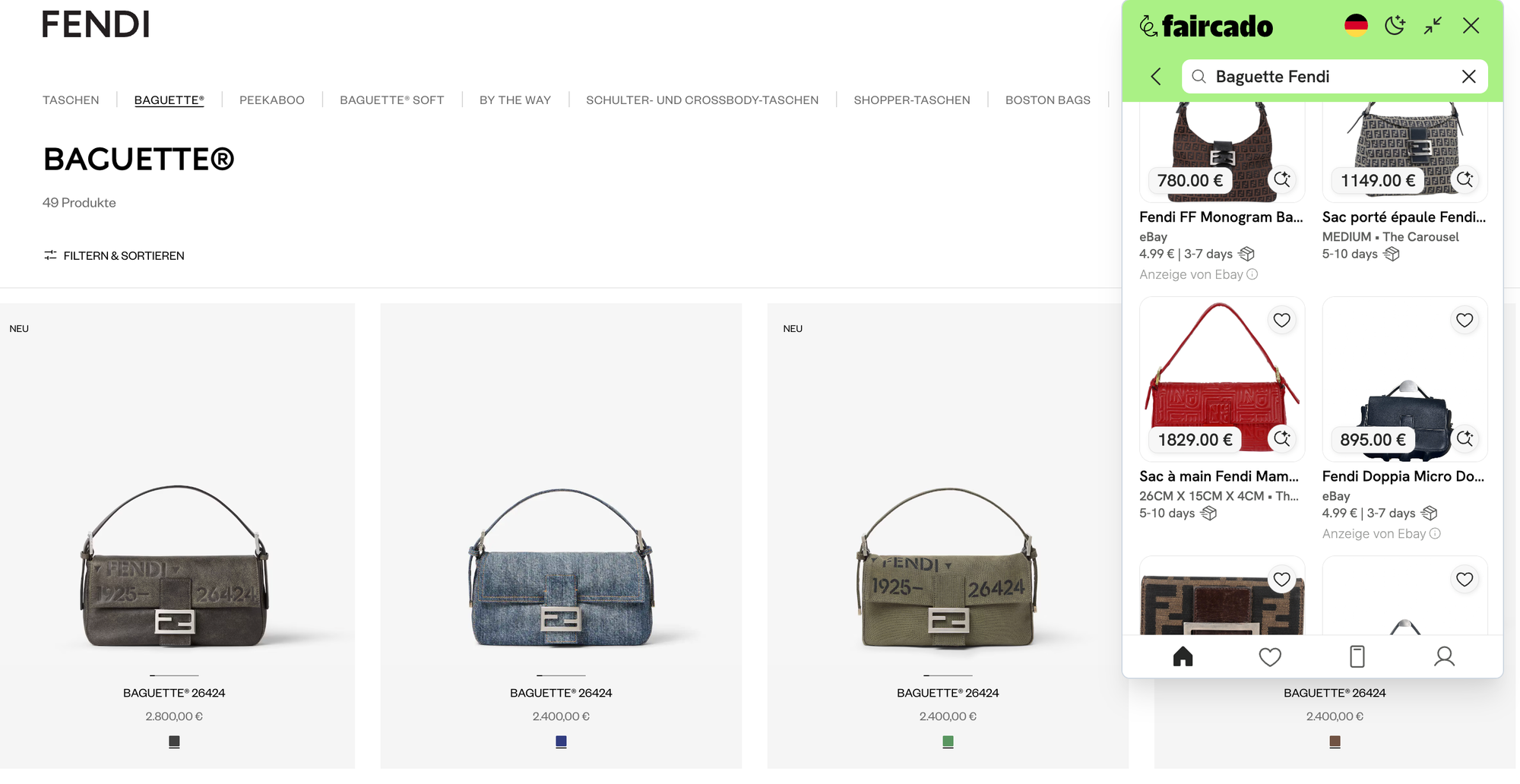
Little demo for ya: I've been obsessed with the Fendi baguette for as long as I can remember (thank you, Carrie Bradshaw). When I browse the Fendi website for a new one, Faircado suggests me a secondhand Fendi baguette for a quarter of the price and in great condition. 10/10
Strong founding team: CEO Evoléna de Wilde (ex-Ecommerce), CTO Ali Nezamolmaleki (built Iran's first online bookstore, key at YC-backed startup), COO Oliver Haver (first exit at 18 with a second-hand marketplace).
Market size: Tapping into a €200B+ sustainability market driven by growing demand for eco-friendly products.
Business model: Revenue-per-click (€0.20–1.00) and commission-based (4-10%) model with potential for further revenue streams.
Traction: Partnerships with 55 platforms; 100k GMV by Dec 2023. (no updated GMV since)
Exit potential: I guess comparable to Honey's $4.5B acquisition by PayPal but the volume of transactions needed to get anywhere near that is making me squint. Honey had 17 million users and 30,000 retail partners generating $100M+ in revenue when PayPal bought it. And even then, people called the price a stretch, mostly justified by PayPal wanting to plug Honey into its own 275 million existing users. Faircado covers 1,600 sites and has raised under $4M so far. Cute comp, but from a VC perspective not sure ... This would need a massive jump in transaction volume, and probably a buyer with as obvious a reason to want them as PayPal had for Honey and I can't think of anyone right now.
Why I like it: Female-founded & mission-driven: Focus on sustainability and circular economy. I'm a loyal user. Recommends me good second hand alternatives when shopping online.
Trosort (B2B)
What they do: AI-powered hardware and software that sorts secondhand clothing for resellers and recycling centers. Trosort scans each item to identify brand, material, condition, size, and resale value, so sorting doesn't have to be done by hand.
Team: Founded in 2023 by CEO Achille Mathot, a mechanical engineer whose interest in the energy transition led him to the environmental cost of fashion. Team of six as of February 2026.
Market size: A €1.44B TAM in textile sorting infrastructure
Business model: Equipment as a service. AI and computer vision auto-tag items from photos: brand, material, condition, size, market value for resellers, brands, take-back programs, and sorting centers.
Traction: Eight systems live across sorting centers in Belgium, The US, the UK, France and more. Targeting 10 by year-end 2026. Currently processing 3 tons of garments per shift, with a roadmap to 90 tons/day. $1.36M raised to date, plus a fresh win: Global Winner of eBay's Circular Fashion Fund 2026, with the option of a $300K investment from eBay Ventures.
Exit potential: Trosort's own roadmap points to a 2027 Series A, so it reads as a company to watch pre-exit rather than one with a visible acquisition path... yet.
Why I like it: Mission driven. Textile sorting is a real pain point that if solved, could unlock so much. Right now, sorting is mostly done by hand, which is slow and expensive, and it's a huge reason so much clothing still ends up landfilled instead of resold or recycled. If Trosort can actually automate that at scale, it could make resale more viable, and become the infrastructure brands need as EU rules around textile waste start getting stricter.
Geniemode
What they do: A B2B platform connecting global fashion and home-goods brands with manufacturers in India and Bangladesh: handling sourcing, sampling, quality control, and logistics so brands don't have to manage it all themselves.
Team: Co-founded in 2021 by CEO Amit Sharma and CFO Tanuj Gangwani, former colleagues at Limeroad, with a combined 20+ years of sourcing experience.
Market size: Riding the growth of Indian textile and apparel exports, a market projected to grow from $222B in 2024 to $647B by 2033! With nearly 60% of global brands planning to expand sourcing from India in the next two years. Geniemode connects buyers in the US, UK, and Europe with 250+ manufacturers across India and Bangladesh.
Business model: End-to-end sourcing platform covering product discovery, design collaboration, quality control, sampling, and logistics, on an asset-light, tech-driven model.
Traction: ~$80M GMV (₹673 crore), with losses narrowing 35% year-over-year to ~$6M (₹51 crore).
Exit potential: The most mature company on this list by revenue and funding stage. Profitability plus Tiger Global and Multiples backing points toward IPO or strategic-acquisition territory (a larger sourcing/logistics platform absorbing it).
Why I like it: Unsexy, and I mean that as the highest compliment. Geniemode already has real revenue: $80M in GMV last year. It's not a profitability story yet but getting there fast.
Haelixa
What they do: Invisible DNA markers embedded directly into raw materials: cotton, gemstones, metals. So brands can physically verify where a material actually came from, at any point in the supply chain.
Team: CEO Patrick Strumpf leads the company, which spun out of ETH Zurich. Board includes Petri Alava (founder of Infinited Fiber) and Anne-Laure Descours, former Chief Sourcing Officer at PUMA.
Market size: Positioned against rising regulatory scrutiny around material claims, undeclared blending, and counterfeiting in fashion, precious metals, and gemstones. No published TAM figure, but the addressable base is every brand facing traceability compliance pressure.
Business model: Plant-based, invisible DNA markers embedded directly into raw materials, verifiable at any point in a multi-tier supply chain. Compliant with GOTS and OEKO-TEX standards; now expanding into anti-counterfeiting for luxury brands specifically.
Traction: The company reports seven-figure revenues and multi-year agreements with leading fashion and textile brands, plus 20+ global awards.
Exit potential: Genuinely scaled commercial traction (revenue-generating, multi-year brand contracts) sets it apart from the earlier-stage names on this list, but there's no disclosed acquisition comp. If anything, the luxury-anti-counterfeiting pivot suggests Haelixa is positioning itself as a future acquisition target for a luxury conglomerate's authentication or compliance stack.
Why I (really really) like it: If it's working, this company could solve some of the industry's biggest problems: greenwashing, counterfeit, ethical sourcing etc. Let me explain: Right now there's basically no way to physically verify a brand's material claims once cotton or any raw material passes through a dozen hands (and countries) in the supply chain. A certificate can be faked or lost, but DNA embedded directly in the fiber can't. If this scales, it could finally give the industry what it's been missing: real transparency in how things are actually made.
Thanks for coming along on this one. I had a lot of fun writing it, and I hope that came through. Let me know what you think: reply to this email, drop a comment, whatever's easiest. I read everything.
See you next month.
— Lauren
Fashion Stack is a personal project. Views are my own.